Advocacy Toolkit
Advocacy Toolkit
The Advocacy Toolkit equips patients and organizations with practical tools, key messages, and shareable resources to raise awareness, challenge unfair patent practices, and support policy change in their countries.
The "Patients and patents" campaign infographic
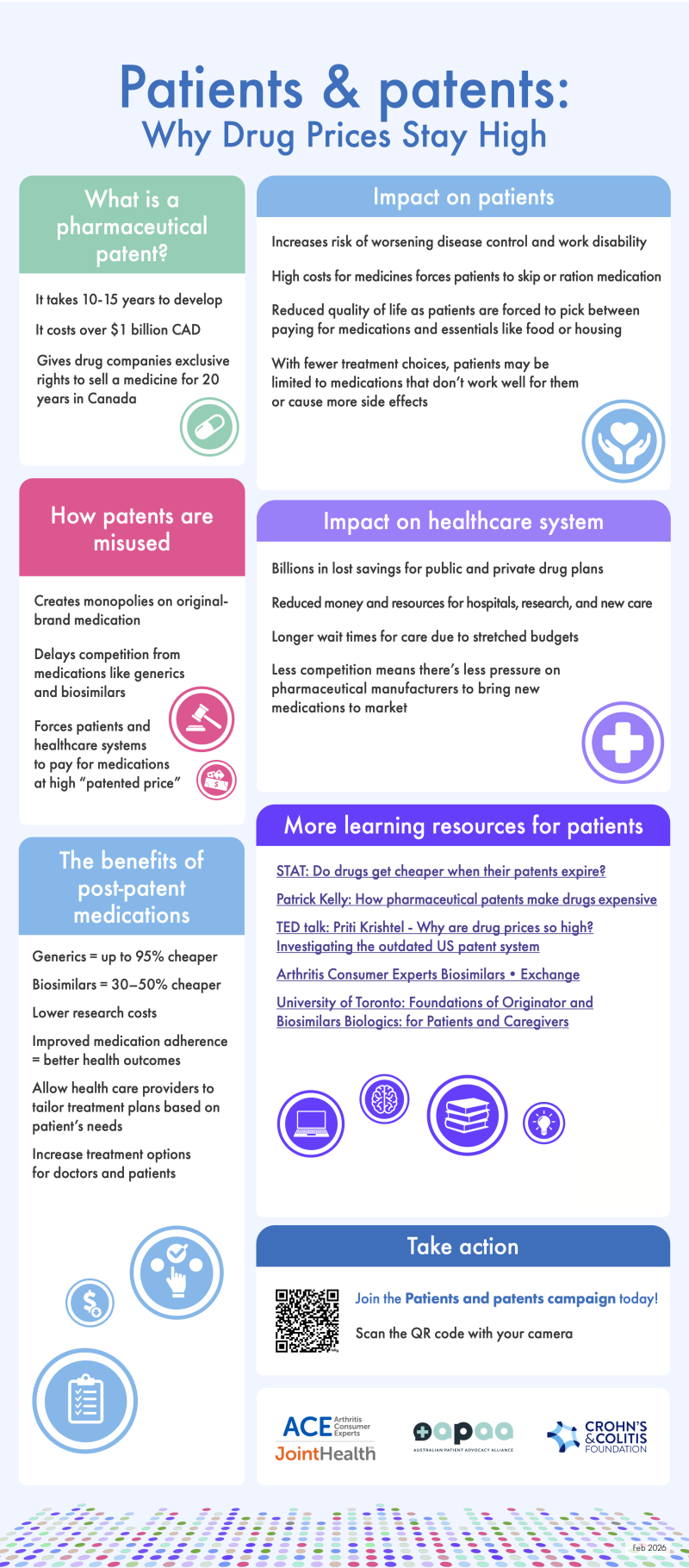
The "Patients and patents" campaign infographic details what a pharmaceutical patent is and looks at some misuses of patent protection and the impact these misuses may have on patients and the healthcare system. The infographic is available digitally, is downloadable, and can be printed front and back on 8 ½” x 11” paper.
Click here to download the infographic.
Take Action on Social Media
Glossary of patent terminology
Pharmaceutical Patent
A form of legal protection that gives a pharmaceutical manufacturer the exclusive right to sell a new original medication for a certain period; in the U.S. and Canada, 20 years from the date of filing. During this time, no other manufacturer is allowed to make, use or sell a generic or biosimilar version of the original medication. This helps the original manufacturer recover the money it spent on research and development and to profit from their discovery for the life of the patent.
Primary & Secondary Patents
A primary patent protects the original active ingredient of a medication. This is the strongest form of patent protection.
Secondary patents often cover small modifications to the medication, such as:
-
- New formulations (e.g., from a tablet to an extended-release version)
- New delivery methods (e.g., an injection instead of a pill)
- New combinations (mixing two old medications together)
Original pharmaceutical manufacturers file multiple secondary patents to block generic or biosimilar entry. Many secondary patents offer little or no new medical benefit, but they maintain the “patented price” of the medication for longer periods of time.
Original Medication
The first version of a medication a country’s regulatory body medications has approved for sale is known as the original medication.
Generic Medications
Generic medications such as aspirin or ibuprofen are small molecules that are chemically synthesized. They contain identical active ingredients as the original medications and are considered the same in terms of dosage form, safety, effectiveness and intended use. Generic medications incur significantly less developmental costs and are offered at a significantly less price than an original medication.
Biosimilar Medications
Biologics – both originator and biosimilar biosimilars – are made from living organisms like yeast and bacteria and are much larger and more complex in nature than conventional, small molecule medicines such as over-the-counter ibuprofen or by-prescription methotrexate.
As patents expire for original biologic medicines, other manufacturers may produce similar biologic medicines known as biosimilars. To receive regulatory approval in the United States, Canada, or Australia, a biosimilar must demonstrate that it is highly similar to the originator biologic and has no clinically meaningful differences in safety, purity, or effectiveness. Because biosimilars build on the research already done for the original product, their development process is generally more streamlined, allowing manufacturers to offer them at lower prices.
Biosimilars are priced significantly lower than their corresponding originator biologic.
-
- 15% to 35% less in the U.S.
- 30& to 50% less in Canada
- 30% to 40% less in Australia
Patent Exclusivity
A legal right that prevents others from making, selling, or using a medication protected by patent rights until the expiry of the last relevant patent. Unlike regulatory exclusivity, which is automatic, patent exclusivity depends on filing and maintaining patents and the outcome of any subsequent patent litigation.
Why it matters:
-
- Manufacturers file multiple secondary patents to create a "patent thicket", prolonging market exclusivity.
- Even if the original patent expires, secondary patents can block generics for years.
Evergreening
A tactic used by pharmaceutical manufacturers to maintain monopoly pricing beyond a medication patent’s original 20-year limit is by making minor changes and filing new patents. This delays generics and biosimilars from entering the market. For example, a company may change the dosage form (from a tablet to an extended-release capsule) or create a new injection device to get a new patent and prolong market exclusivity of the medication.
Patent Thicket
A strategy where a pharmaceutical manufacturer files dozens (or even hundreds) of overlapping patents on a single medication to make it harder for generics and biosimilars to enter the market.
Patent Linkage System
Patent linkage is a legal rule that connects the approval of a lower-cost medicine (like a generic or biosimilar) to the patent status of the original brand-name medicine. Before the generic version can be sold, regulators must check if the original medication’s patent is still in effect; in some countries, this may delay or block approval until any patent issues are resolved.
Learn more about pharmaceutical patents in your country
The organizational partners in the Patients and patents campaign are here to help. If you have questions about how pharmaceutical patents work in your country, or how patent strategies can affect access to affordable medications, you can find reliable information and support from our partner organizations:
-
- Arthritis Consumer Experts (Canada) — a national patient‑led organization providing education and advocacy programs to people with arthritis. Contact: feedback@jointhealth.org
- Australian Patient Advocacy Alliance (Australia) — a collective of national health advocacy groups representing patients with complex and chronic diseases. Complete the form on their “Contact Us” page to connect.
- Crohn’s & Colitis Foundation (USA) — a leading nonprofit focused on improving the lives of people with inflammatory bowel diseases, including advocacy resources and tools. Contact: info@crohnscolitisfoundation.org
Each partner can better help you understand patent issues in your country or jurisdiction, connect you with advocates, and get involved in improving access to affordable medicines.